September 25 – October 31, 2021
The Glen, Gladwyne, Pennsylvania
Curated for InLiquid
Overview
Sculpture in the Glen III brought together more than 30 regional artists whose work was situated across the woods, lawns, creek beds, pathways, and clearings of a private property in Gladwyne.
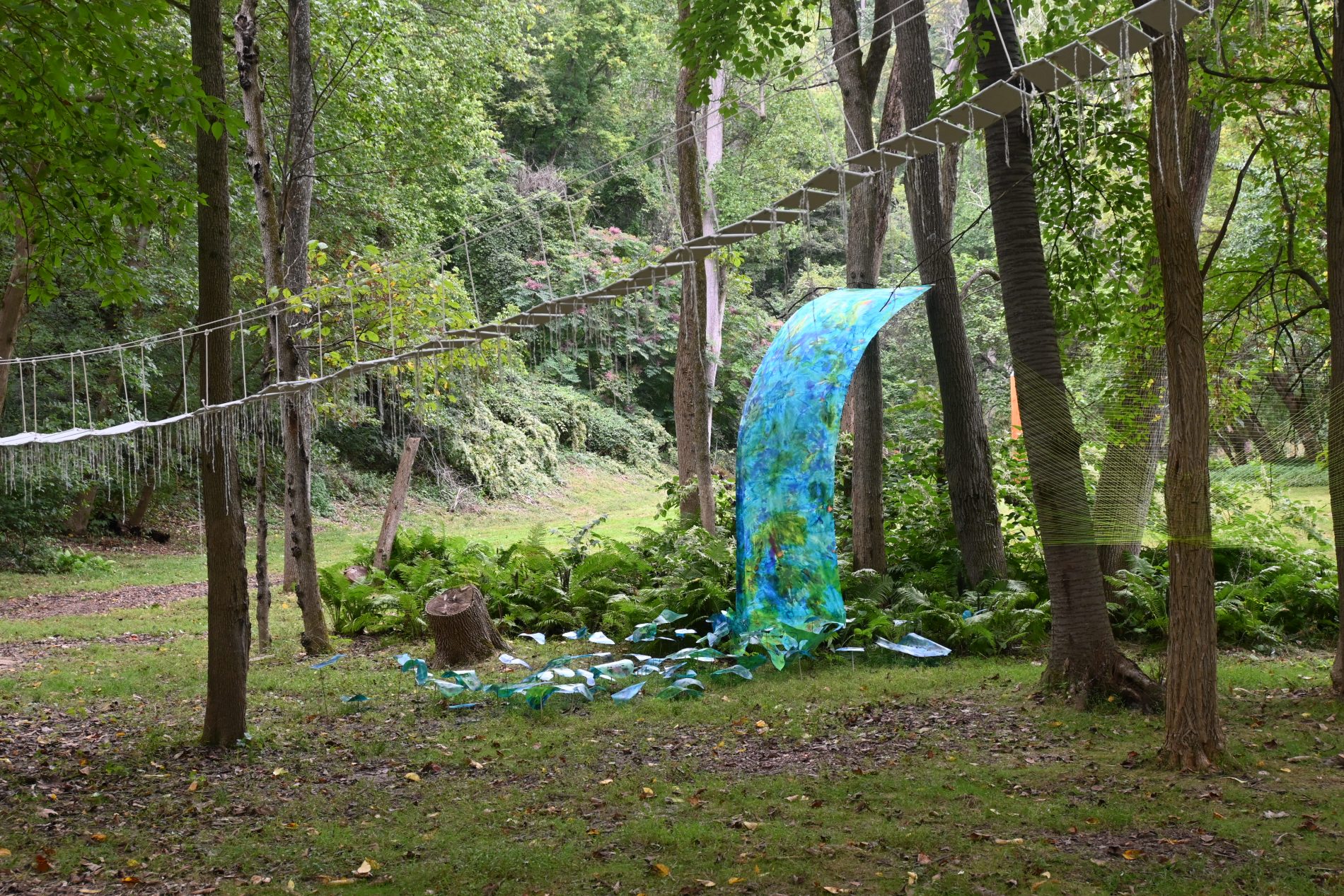
The exhibition included more than 40 works in metal, wood, fiber, glass, clay, stone, found materials, light, and sound. Some artists developed new site-specific installations. Others adapted existing works in response to the property’s trees, water, topography, changing light, and scale. I worked with each artist to consider how the site could shape the work’s meaning and experience. Sculptures emerged from the ground, crossed the creek, hung between trees, reflected the canopy, and changed with the weather.
The exhibition asked: What happens when sculpture is understood not as an object placed in nature, but as part of a living and constantly changing environment?
InLiquid presented the month-long exhibition in collaboration with the Burch Family and Friends of the Glen. It was open to the public on weekends, with additional visits available by appointment.
Curatorial Approach
Sculpture in the Glen III took place during a period when artists, cultural organizations, and audiences were still navigating the effects of the COVID-19 pandemic.
Indoor gathering remained complicated. Many artists had lost opportunities to exhibit their work, while audiences were seeking ways to reconnect without giving up the distance and caution that had shaped the previous year.
The Glen offered another kind of exhibition space. Visitors could move through the property at their own pace, remain physically separated, and still share the experience of encountering art and one another. People appeared and disappeared along paths, gathered briefly around sculptures, and occupied the same landscape without needing to remain in one enclosed room.
That context shaped my curatorial approach. The exhibition was not simply transferred outdoors. It was developed around outdoor attention: walking, changing light, uneven ground, weather, ambient sound, long sight lines, and the possibility of discovery.
Several artists also responded directly to the emotional and material conditions of the pandemic. Wendy Liss described Presence through the paradox of feeling freed while confined. Heather Ossandon’s Catch gathered masks, plates, fruit, and domestic objects into a sculptural memory of life at home. Francis Beaty spoke about bringing work into nature and public space at a time when access to galleries had diminished.


Clockwise from top left: Annette Cords, A Crossing; Erica Ehrenbard & Zachary Steinheiser, 21 Reliquary Remains; John Schlesinger, Untitled (retinal); rod jones ii, untitled; Diane De5e7ry Richards, Washed Away
Site-responsive work
Many of the works became inseparable from their locations.
Francis Beaty’s Offering appeared as a procession of folded gold, orange, and red aluminum forms among the trees. Their metallic surfaces caught and redirected natural light, moving between botanical growth, industrial construction, and ceremonial gathering.
Annette Cords stretched colored monofilament between trunks in A Crossing, creating a drawing that appeared and disappeared as visitors moved through the grove.
Katee Boyle’s Dory 1, Child and Dory 2, Parent crossed and occupied the creek through rope, wire, ribbon, lace, and surrounding branches. The installation linked ideas of family, memory, protection, and instability to the physical movement of water.
In Earth, Michael Morgan embedded a low brick form into the forest floor. The work returned an architectural material to its origins in clay and earth, rewarding close attention rather than distant viewing.
Hanna Vogel’s The Rise and Rise stretched between trees like a suspended bridge, skeletal shelter, or remnant of an unfamiliar structure. Its visual delicacy heightened the work’s concern with growth, decay, and environmental vulnerability.
John Schlesinger’s assemblages of salvaged signage, neon, laboratory equipment, cast materials, and solar components resisted the expectation that sculpture should quietly harmonize with the woods. The works appeared instead as strange electrical organisms embedded in the landscape.
Clockwise from top left: Francis Beaty, Offering; Annette Cords, A Crossing; Katee Boyle, Dory 1, Child; Michael Morgan, Earth; Hanna Vogel, The Rise and Rise; John Schlesinger, Untitled


Clockwise from top left: Hanna Vogel, The Rise and Rise; Michael Morgan, Earth; Nancy Agati, River Meditation
Public programming
Public programs created different ways to experience the exhibition through conversation, movement, sound, and shared attention.
A vernissage brought artists, supporters, and visitors together across the property. Rather than concentrating everyone in one room, the gathering spread through the paths, lawns, and sculpture sites.
Guided tours offered an in-depth look at how the exhibition was developed and how individual artists responded to the Glen. I led tours with InLiquid Executive and Artistic Director Rachel Zimmerman and participating artists, discussing the relationship among artwork, placement, and landscape. The exhibition included more than 40 works by over 30 artists.
A walk and talk with John Wind focused on the work and legacy of his mother, Dina Wind, whose stainless-steel sculptures were installed together within the landscape.
Yoga in the Glen invited visitors to experience the site through breath, balance, bodily awareness, and movement. The program extended the exhibition’s interest in how the body moves through and responds to space.
These events shaped how visitors slowed down, returned to the site, encountered the work through other people, and experienced the Glen as a temporary shared cultural space.
Interpretation beyond the physical site
The scale and density of the property required interpretation that could move with the visitor.
I created an interactive Google map that located works throughout the Glen and connected visitors with information about each artist and installation. The map offered orientation without prescribing a single route, allowing people to wander, discover, and return.
I also engaged local DJ Roman Let Us to curate a Spotify playlist inspired by the artworks and atmosphere of the site. Visitors could listen while walking, adding another interpretive layer based on rhythm, memory, mood, and duration.
I directed and contributed to a full exhibition catalog documenting the participating artists, their statements, the materials and dimensions of each work, and installation views. QR codes connected the printed publication to the interactive map, playlist, and online sales platform.
To preserve the exhibition, I commissioned video documentation. Moving through the site, the video documents the relationship between the work and the landscape while also capturing artists during installation and speaking about their processes, materials, and ideas. The walkthrough and artist reflections offer a fuller record of how the exhibition was experienced in place and allow the project to remain accessible after the physical installation has ended.
Curatorial role
I curated Sculpture in the Glen III and worked directly with participating artists to develop site-responsive installations throughout the property.
My role included selecting and placing work, walking the site with artists, identifying locations, supporting adaptations and new installations, coordinating conceptual relationships among works, coordinating installation and installation support, shaping visitor movement, developing interpretation, creating the interactive map and playlist, directing the catalog, and developing public programming.
The project required curatorial judgment alongside practical problem-solving around scale, weather, stability, hanging, anchoring, electricity, water, access, wildlife, and visitor safety.
During a period defined by separation, the Glen became a place where artists could create ambitious work and where visitors could remain physically distant without being isolated from art or from one another.
All images courtesy of InLiquid