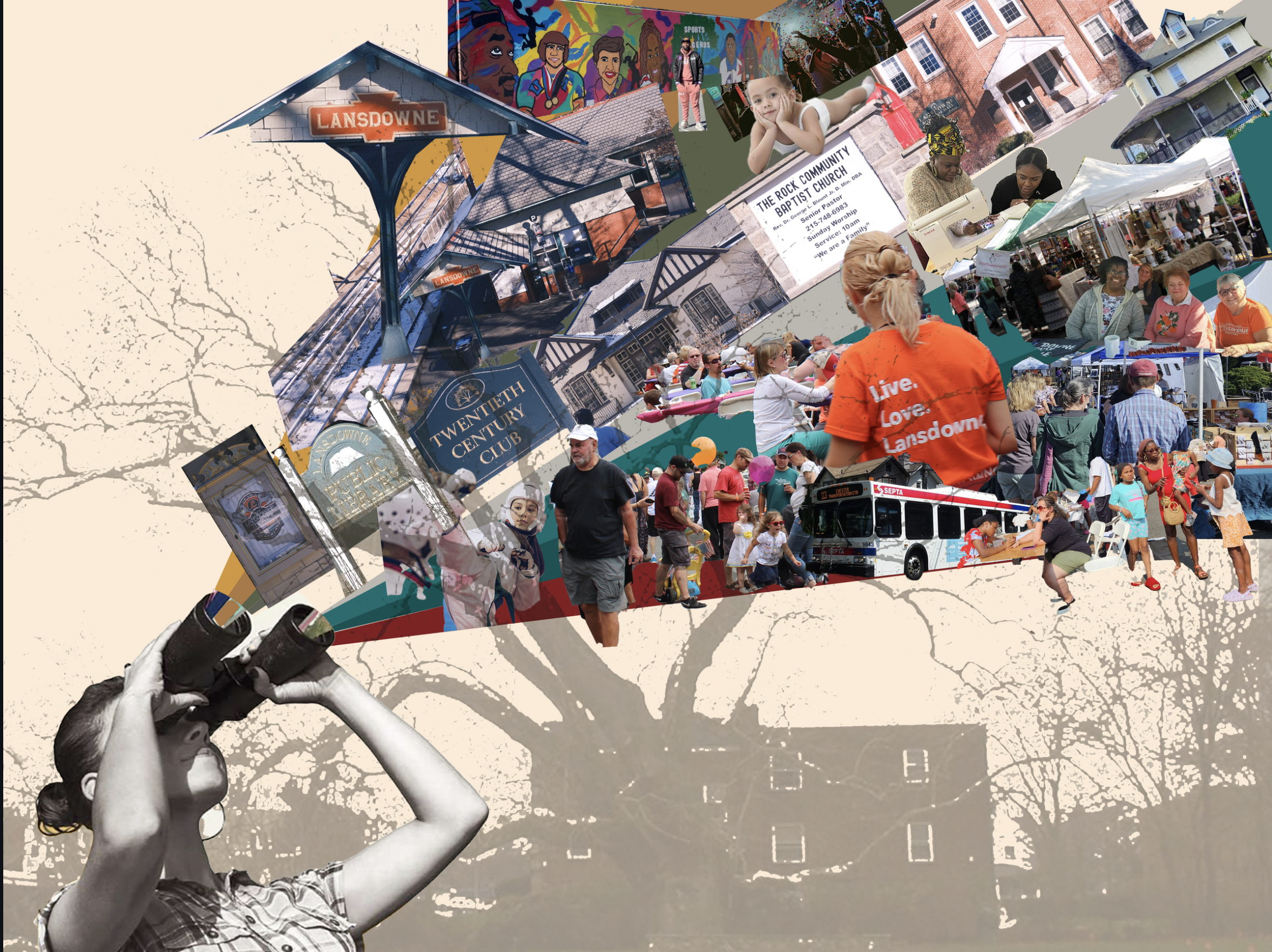
Image courtesy of “From “Downtown Lansdowne: Strengthening the core, securing the future”, Chen, de la Rosa,
Grossman, Guo, Luning, & Sun (2025, May 8), unpublished class presentation, CPLN 6000, University of Pennsylvania
2026–2030 Strategic Plan
Lansdowne Economic Development Corporation
Lansdowne, Pennsylvania
A five-year strategy connecting arts, small business, public life, and community well-being.
Engagement snapshot
Organization
Lansdowne Economic Development CorporationEngagement context
Embedded executive leadership + organization-wide strategic planningTimeframe
2025 planning process; 2026–2030 implementation horizonScope
Community research, priority setting, implementation design, measures, ownership, funding dependencies, and public communicationPrimary output
A five-year strategy with internal implementation structures and a public-facing planTransferable engagement
Strategic planning can be scoped to one decision, initiative, department, or the organization as a wholeThe Project
Lansdowne already possessed many of the assets associated with a strong local creative economy: working artists, small businesses, cultural organizations, public events, historic commercial corridors, walkable neighborhoods, and a community that strongly identified with the arts.
LEDC’s programming had also grown. Its work included exhibitions, 2 annual arts festivals, a farmers market, artist studio spaces, maker-space resources, public-space activation, business support, volunteer engagement, and community communications.
The challenge was to connect that activity within a shared framework for investment, implementation, and accountability that was Borough-wide.
The five-year planning process needed to:
- clarify LEDC’s role in local economic development
- translate community priorities into strategic choices
- connect existing programs to longer-term public outcomes
- establish ownership, timelines, budgets, and measures
- strengthen the case for public and philanthropic investment
- communicate the strategy differently to internal, institutional, and public audiences
Public Works: Art + Economy became both an organizational strategy and a public framework for understanding how creativity, commerce, public space, and community life could reinforce one another

Image courtesy of “From “Downtown Lansdowne: Strengthening the core, securing the future”, Chen, de la Rosa, Grossman, Guo, Luning, & Sun (2025, May 8), unpublished class presentation, CPLN 6000, University of Pennsylvania
COMMUNITY AND STRATEGIC CONTEXT
Lansdowne is a one-square-mile inner-ring suburb located six miles from Center City Philadelphia. It combines regional transit access, historic architecture, comparative affordability, a diverse population, an active creative community, and a compact downtown business district.
At the time of planning, the borough included:
- more than 11,000 residents
- more than 300 local businesses
- more than 100 identified artists
- 12 arts and culture organizations
- a growing portfolio of public and private investment, including the restoration of the Lansdowne Theater
The planning process identified five connected needs:
- Clarify Downtown Lansdowne’s public identity
Lansdowne had recognizable local strengths, but they were not consistently translated into one clear public proposition. - Coordinate programs and investments
Arts, business support, public space, and community programming often created value independently. The opportunity was to make them reinforce one another. - Expand practical support for small organizations and businesses
Local partners needed more than visibility. They needed technical assistance, stronger networks, funding access, and help converting ideas into executable plans. - Align new investment with local capacity
Major capital and public-space investments created opportunity, but also increased the need for coordinated planning and long-term stewardship. - Strengthen the operating backbone
Implementation required clear ownership, staff capacity, data systems, volunteer structures, governance, financial discipline, and ongoing evaluation.

Candid view of Community Meeting held as part of the planning process
RESEARCH AND DISCOVERY
The strategy was developed through a mixed-methods process combining community input, business insight, market data, public planning, and organizational knowledge.
The research included:
- an LEDC community survey with 122 responses
- a community-informed public art plan
- a targeted business survey and interviews with 25 partners
- a Pennsylvania Downtown Center Community Perception Survey with 360 responses
- more than 100 pages of Claritas market and audience data
- review of the Lansdowne Borough Comprehensive Plan and Council priorities
- two community input meetings attended by 71 participants
- ongoing conversations with artists, business owners, nonprofits, volunteers, public officials, and institutional partners
I looked for patterns across sources and tested those patterns against organizational capacity, public value, funding requirements, and long-term economic potential. Questions asked were:
- What internal capacity would be required before public implementation?
- Which assets did different audiences consistently value?
- Where were residents and businesses experiencing friction?
- Which needs could LEDC credibly address?
- Where could one investment produce value across multiple systems?
WHAT THE RESEARCH REVEALED
The strategy grew from a broader shift in how I understood the organization’s work. An exhibition was not only a cultural experience. It could support artists, attract visitors, create foot traffic, generate press, introduce residents to a public asset, and strengthen Lansdowne’s identity. A farmers’ market was not only a place to buy food. It could support small businesses, improve food access, create paid opportunities for artists and musicians, host community partners, and function as a weekly civic gathering place. A studio building was not only real estate. It could provide affordable workspace, shared resources, exhibitions, professional development, and a foundation for long-term cultural infrastructure.
The work became increasingly focused on connection: between artists and businesses, events and commerce, public space and quality of life, community input and planning, cultural identity and economic strategy. Public Works was a way of seeing separate programs as parts of one system, and separate parts of our civic life as integrated
Lansdowne had a strong identity, but no clear shared message
Residents consistently valued Lansdowne’s walkability, historic character, cultural energy, affordability, diversity, and inclusiveness. These qualities formed a strong sense of place, but they were not consistently communicated as the reason to visit, invest, participate, or remain in Lansdowne.
Strategic implication
Build recognition around authentic local assets rather than invent a generic destination brand.
Arts and culture already functioned as infrastructure
Community input connected festivals, exhibitions, public art, artist studios, family programming, and cultural events with belonging, foot traffic, local identity, and public life.
Arts and culture were already doing economic and civic work. The strategy needed to connect it more deliberately to business support, public space, and community investment.
Strategic implication
Treat arts and culture as part of the economic-development model, not as a separate amenity or program category.
Businesses needed capacity and connection, not promotion alone
Business owners expressed interest in networking, technical assistance, funding access, merchandising support, collaboration, and practical help navigating opportunities.
Visibility mattered, but promotion alone could not resolve limited staffing, fragmented information, or weak connections among local sectors.
Strategic implication
Combine communications with practical assistance, shared resources, funding pathways, and relationship-building.
Organizational capacity was part of the strategy
Successful implementation depended on staffing, data, volunteer structures, governance, financial controls, grant compliance, and clear ownership.
Visible public activity could not be sustained without a less visible operating backbone.
Strategic implication
Pair every public-facing initiative with the infrastructure required to deliver, monitor, and improve it.
THE STRATEGIC FRAMEWORK

Graphic of Public Works Strategies and Impacts
Public Works treats four systems as mutually reinforcing components of a human-based local economy:
- Arts and culture
- Small business
- Public space
- Community life
The strategic premise is that when these systems reinforce one another, each investment produces broader public value.
Art and events draw people downtown. Active public spaces encourage use and care. Foot traffic spurs economic activity that supports local businesses. Local commerce and civic participation reinvest value in place.
The strategy was also concerned with circulation. How could more money remain in the local economy? How could one program create participation in another? How could an exhibition visitor discover a restaurant, business, market, workshop, or future event? How could community participation lead to paid work, leadership, or sustained involvement? How could public investment support both immediate activity and durable local infrastructure?
The goal was to create more reasons for attention, opportunity, relationships, and economic value to remain there.
FROM PROGRAMMING TO ECONOMIC STRATEGY
The strategy grew from a broader shift in how I understood LEDC’s work.

An exhibition could do more than present art
It could pay artists, attract visitors, create foot traffic, generate press, introduce residents to a public asset, and strengthen Lansdowne’s identity.

A farmers market could do more than sell food
It could support micro-businesses, improve food access, create paid opportunities for artists and musicians, host community partners, and function as a recurring civic gathering place.

A studio and maker-space building could do more than provide real estate
It could preserve affordable workspace, provide shared equipment, support exhibitions and professional development, generate earned revenue, and establish long-term cultural infrastructure.

A public event could do more than create one day of activity
It could build audiences, create vendor income, support local businesses, recruit volunteers, gather data, generate media coverage, and introduce participants to future opportunities.
Public Works translated those connections into an economic-development framework. It allowed programs that had previously been discussed separately to be understood as parts of one coordinated system.
FROM PUBLIC VISION TO OPERATING ARCHITECTURE
The written plan was designed to serve as both a five-year strategic framework and a practical management document that staff, board members, partners, and funders could use to guide decisions over time.
It followed the requirements of Pennsylvania’s Main Street Matters program, which asks designated communities to connect local research and public input to clear transformation goals, measurable strategies, and an actionable work plan. The plan also aligned each initiative with the Main Street framework of Organization, Promotion, Design, and Economic Vitality.
The final written plan contained sections on:
- community and market context
- mission and strategic position
- three public transformation goals
- supporting organizational goals
- strategy-level measures of success
- project ownership and partnerships
- five-year timelines
- outputs and intended outcomes
- budget assumptions and funding dependencies
- Main Street alignment
- monitoring, evaluation, and public reporting
A corresponding strategy plan was also produced, in which each strategy was translated into specific projects with assigned leads, partner roles, timelines, budgets, dependencies, measures, and implementation status. This level of detail made it possible to distinguish between ongoing work, new priorities, and initiatives that depended on future funding or partnership development.

Example page from strategy implementation plan
The central conclusion was that Lansdowne did not need an unrelated collection of new programs. It needed a coordinated system for connecting existing assets, directing new investment, measuring collective value, and sustaining the organizational capacity required to deliver the work.
MONITORING, EVALUATION, AND PUBLIC COMMUNICATION
Public Works formally entered implementation in August 2025. The 2025 Impact Report therefore served as a baseline for future evaluation and evidence of the organizational capacity on which the strategy would build.
The report established measures across reach, access, business support, artist participation, volunteerism, public-space use, and estimated economic impact.
The reporting system was then translated for broad accountability. The same evidence was translated into different templates for varying levels of attention and context.
Annual impact report
A consolidated public record connecting participation, access, economic value, organizational activity, and long-term strategy.

2025 Impact Report, designed by Clare Finin
Social communications
Modular messages that extended the reporting cycle and selected individual outcomes in alignment with community members’ interests.


2025 Impact Social Carousel, designed by Clare Finin
Early indicators and organizational impact
Because Public Works formally entered implementation in August 2025, it is too early to attribute longer-term community outcomes to the strategy.
The work did, however, establish a stronger foundation for implementation:
- LEDC was accepted as Lansdowne’s designated managing entity under Pennsylvania’s Main Street Matters program.
- Community research was translated into a five-year strategy and project-level roadmap.
- Programs, communications, donor activity, volunteers, and evaluation were connected through an integrated data system.
- Public reporting established a baseline for measuring future implementation.
Public Works offers a structural change. Programs that had previously operated in parallel could now be understood, planned, and evaluated as parts of one local economic system.

News coverage
My role
As Executive Director of the Lansdowne Economic Development Corporation, I served as the internal lead for Public Works and worked closely with strategy consultant Colin Vaida, who led key portions of the formal strategic-planning process.
Colin brought an external planning perspective, helped structure the process, and facilitated strategic conversations between staff and the Board. I contributed the organizational and community knowledge that grounded the work, designed the surveys, led the community input meetings, helped interpret the research, shaped the strategic direction, and ensured that the final plan reflected LEDC’s actual programs, partnerships, capacity, and operating environment. I also led the visual design and public-facing communications.
My role included:
- defining the organizational needs the plan had to address
- designing and interpreting community and business research
- leading public input meetings and synthesizing community feedback
- helping identify priorities, risks, and implementation constraints
- shaping the transformation goals, strategies, measures, and work plans
- connecting proposed initiatives to staff capacity, partnerships, budgets, timelines, and funding dependencies
- writing and refining significant portions of the plan and supporting materials
- building systems for implementation, evaluation, reporting, and continued public communication
- directing the public narrative, visual approach, and audience-specific communications
- translating the strategy into materials for state reviewers, board members, funders, partners, businesses, and residents
WHAT THIS DEMONSTRATES
Public Works translated community knowledge into priorities, priorities into a five-year operating structure, and that structure into distinct materials for decision-makers, partners, funders, and the public.
The project reflects how I approach strategy more broadly: I look for the relationships among programs, people, information, and institutional structures. Then I build a framework that makes those relationships easier to understand, manage, evaluate, and support.
Strong strategy does more than describe a future. It gives people a shared way to make decisions and begin building it.